Auto Loan Rates in May 2026: What You're Actually Paying Right Now
Auto loan rates in today's market vary widely depending on your credit score, loan term, and whether you're buying new or used. Here's a quick snapshot of where rates stand right now:
Loan Type | Average APR | Typical Term |
|---|
New car loan | 6.97% | 60 months |
Used car loan | 11.54% | 67 months |
Best available (new) | From 3.39% | 36 months |
Best available (used) | From 4.79% | 12-36 months |
Super prime (781+ score) new | 5.27% | 60 months |
Quick answer: A good auto loan rate in May 2026 is roughly 5.5–6.5% for new cars and 6–7% for used cars if you have excellent credit (720+). Most borrowers pay more.
Finding the right financing can feel overwhelming. Rates shift week to week, lenders use different criteria, and the difference between a good rate and a bad one can cost you hundreds of dollars over the life of your loan. Even a 0.5% difference on a typical car loan adds up fast.
The good news? Once you understand how rates are set and what lenders are actually looking for, you have real tools to negotiate — and save.
I'm Marcos Bravo, a luxury and exotic automotive sales specialist with over 25 years of experience in South Florida's competitive car market. Helping clients navigate auto loan rates and financing options has been a core part of my work at Autobon Motors, and I've seen what separates buyers who get great deals from those who leave money on the table. Let's make sure you're in the first group.
Current Average Auto Loan Rates in May 2026
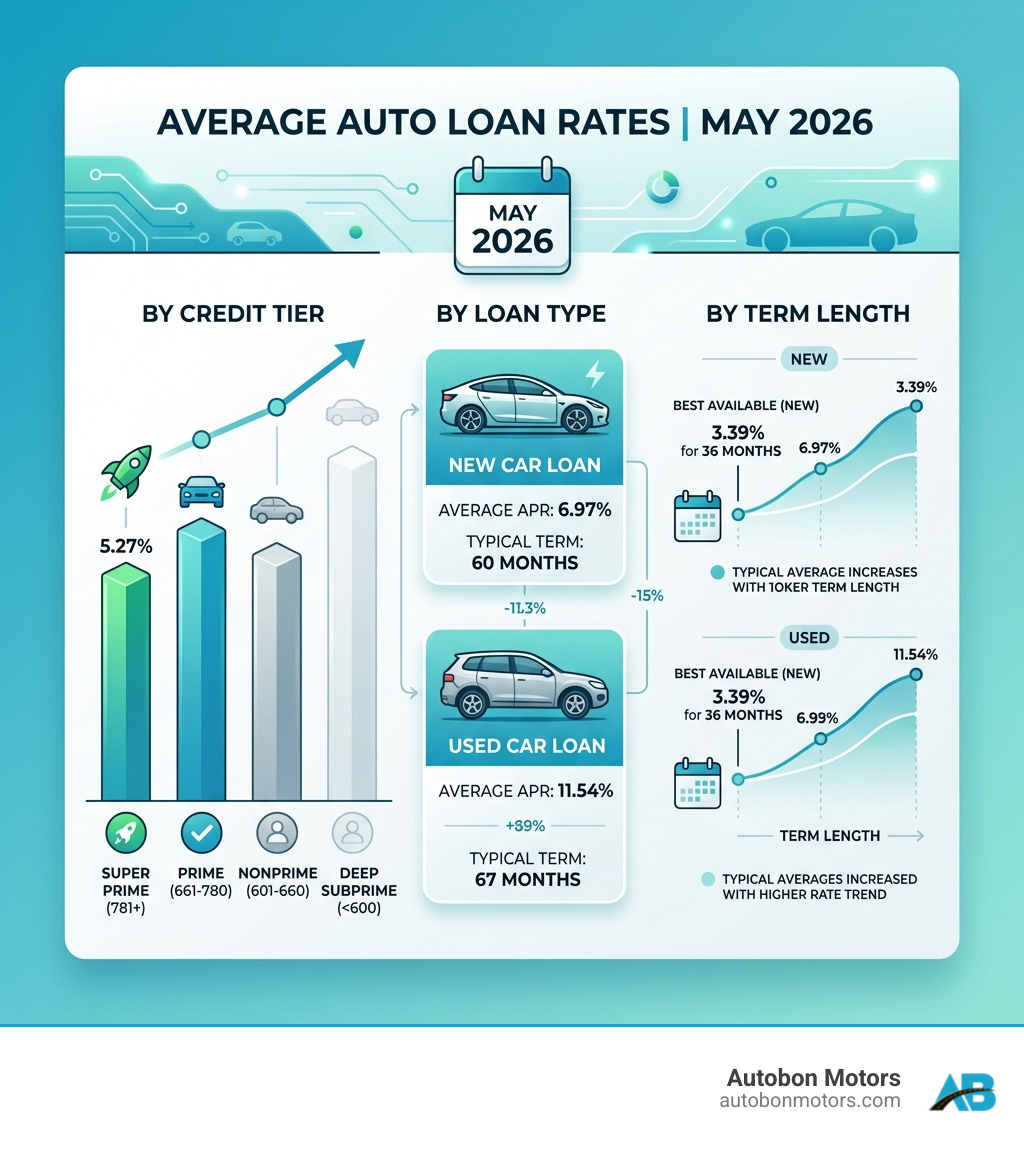
Auto loan rates have shown some interesting shifts as we move through the middle of 2026. While the market has stabilized compared to the volatility of previous years, borrowers still need to be diligent. According to the latest data from Average Auto Loan Rates in May 2026 | U.S. News, the benchmark rate for a 60-month new car loan currently sits at 6.97%.
However, the gap between new and used car financing remains significant. For a used car, the average interest rate is notably higher at 11.54%. This disparity often comes down to how lenders view the collateral; a used car carries more "depreciation risk" and potential for mechanical issues that could lead to a loan default.
Here is a breakdown of what the typical loan looks like in today's market:
Category | New Car Average | Used Car Average |
|---|
Average Loan Amount | $41,983 | $26,795 |
Average Interest Rate | 6.80% - 6.97% | 11.54% |
Average Monthly Payment | $749 | $529 |
Average Loan Term | 68.87 Months | 67.2 Months |
Understanding these averages is the first step in knowing if you are getting a fair deal. If you're shopping for a vehicle in Fort Lauderdale or Miami, we always recommend using our Loan Calculator to see how these percentages translate into real monthly dollars. Even a small move of 0.5% in your APR can save you hundreds of dollars over the life of a $35,000 loan.
How Credit Scores Dictate Your Interest Rate
Auto loan rates are, more than anything else, a reflection of your "risk profile" in the eyes of a bank. Your FICO score is the primary tool lenders use to decide how likely you are to pay them back. In 2026, the market is strictly tiered, and moving up just one credit bracket can result in thousands of dollars in savings.
Data from Auto Loan Rates and Financing for 2025 shows that "Super Prime" borrowers—those with scores of 781 or higher—are enjoying the best terms. For this group, new car APRs average around 5.27%, while used car APRs sit near 7.15%. On the other end of the spectrum, "Deep Subprime" borrowers (scores 300-500) may see used car rates as high as 21.58%.
Here is a look at how the tiers generally break down:
Super Prime (781-850): The gold standard. You get the lowest advertised rates.
Prime (661-780): You'll still qualify for very competitive rates, usually just a point or two above the minimum.
Nonprime (601-660): Rates start to climb significantly here.
Subprime (501-600): You may need a larger down payment or a co-signer to secure a reasonable rate.
Deep Subprime (300-500): Focus on lenders who specialize in "second chance" financing.
Qualifying for the Lowest Auto Loan Rates
To lock in the absolute lowest auto loan rates, you generally need a FICO score of 720 or higher. But your score isn't the only thing on the menu. Lenders also look at your Debt-to-Income (DTI) ratio. Ideally, you want your total monthly debt payments to be below 35% of your gross monthly income.
If you’re worried about your score, don’t panic. Many modern lenders allow for a "soft credit pull" to give you a pre-qualification. This lets you see your potential rates without any impact on your credit score. When you're ready to get serious, you can fill out our Credit Application to see exactly what you qualify for in the South Florida market.
Comparing New vs. Used Auto Loan Rates
Why is there such a gap between new and used car rates? It's all about the math of the machine. As Auto Loan Rates & Financing in 2026 | Bankrate points out, used cars are harder for lenders to value accurately, and their depreciation is less predictable.
Interestingly, the industry has a "sweet spot" known as late-model used. Vehicles with between 7,500 and 30,000 miles are technically used, but some lenders may offer them rates closer to new car levels because they still represent low-risk collateral. Once a car crosses that 30,000-mile or 2-year threshold, you can expect the APR to jump by 1% to 1.5%.
Factors That Influence Your Personal APR

When you sit down to talk about auto loan rates, several invisible forces are at play. It’s not just about you; it’s about the economy at large.
The Federal Reserve: The Fed sets the benchmark interest rate. When they raise or lower it, auto lenders usually follow suit within days.
The Bond Market: Lenders often look at the yield on Treasury bonds to price their long-term loans.
Loan-to-Value (LTV) Ratio: This is the ratio of the loan amount to the car's actual value. If you're trying to finance 125% of a car's value (to cover taxes, fees, or negative equity), your rate will be higher. Keeping your LTV at 80% or less is a surefire way to lower your APR.
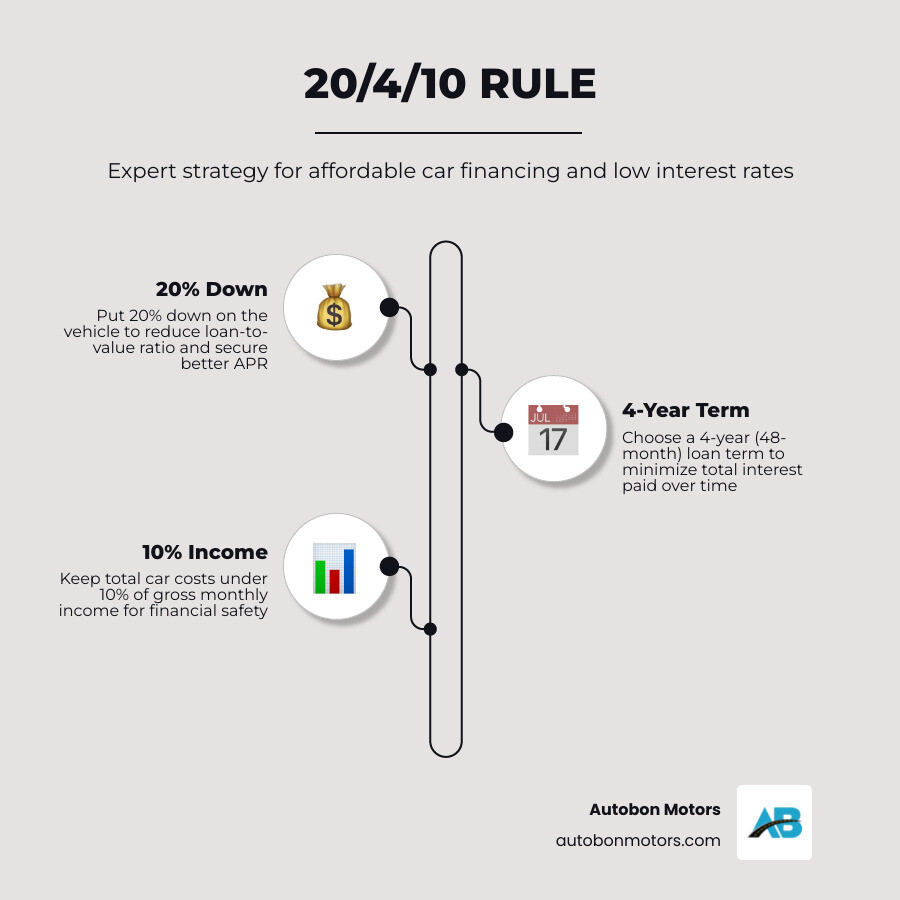
The 20/4/10 Rule: This is a classic expert strategy. Aim for a 20% down payment, a 4-year loan term, and ensure your total car costs (including insurance and fuel) are under 10% of your gross income. Following this rule not only makes you look like a "well-qualified buyer" but also minimizes the total interest you'll pay.
Strategic Ways to Lower Your Monthly Payment
We know that for most of our neighbors in Hollywood and Dania Beach, the monthly payment is what matters most for the family budget. Here are the most effective ways to drive that number down without just extending the loan term to 84 months (which we usually advise against!):
Refinancing: If you bought a car a year ago when your credit was lower, you might be able to refinance now. The average refinance customer saves about $150 per month.
Co-signers: If your credit is in the "fair" or "poor" range, a co-signer with a 700+ score can instantly slash your interest rate by half in some cases.
Relationship Discounts: Many large banks offer a 0.25% to 0.50% discount if you set up automatic payments from a checking account with them.
Leasing: If you want the lowest possible monthly payment for a new vehicle, Leasing is a strong alternative. In May 2026, the average lease payment is about $612—significantly lower than the $749 average for a new car loan.
Frequently Asked Questions about Auto Financing
Do credit unions or banks offer better rates?
Generally, credit unions offer the lowest auto loan rates because they are member-owned, non-profit organizations. For example, some credit unions in early 2026 were offering rates as low as 2.99% for short-term loans. However, big national banks often provide better digital tools and "relationship discounts" for existing customers. It’s always worth checking both.
How do loan terms affect my total interest?
The longer the term, the higher the rate. While an 84-month loan makes your monthly payment small, the interest rate is usually 1% to 2% higher than a 48-month or 60-month loan. Over seven years, you could end up paying thousands more for the same car. We recommend staying at 60 months or fewer if your budget allows.
Can I get a loan with a 500 credit score?
Yes, you can. There are specialized lenders who work with credit scores as low as 300 to 510. However, be prepared for "subprime" rates, which can exceed 20%. In these cases, we recommend making the largest down payment possible to reduce the amount you're borrowing at that high rate, and then looking to refinance after 12 months of on-time payments.
Conclusion
At the end of the day, securing the best auto loan rates is about being prepared. Don't wait until you're in the dealership's "F&I" office to start thinking about interest. By knowing the current averages, checking your credit score early, and understanding the factors that move the needle, you put yourself in the driver's seat of the negotiation.
At Autobon Motors, we pride ourselves on a customer-focused approach. Whether you're in Fort Lauderdale, Miami, or Hallandale Beach, our goal is to provide fair prices and superior service. We want you to drive away in a quality used car, truck, or SUV with a financing plan that makes sense for your life.
Ready to stop guessing? Apply for Financing Today and let our team help you find the best rate available for your next vehicle. We look forward to seeing you on the lot!
