The Test Drive Question Every Used Car Buyer Needs to Answer First

How long should you test drive a used car? Here's the quick answer before we dive deeper:
Test Drive Type | Recommended Duration | Best For |
|---|
Standard drive | 15-30 minutes | Most buyers, basic evaluation |
Thorough evaluation | 30-45 minutes | Serious contenders, used vehicles |
Extended/overnight | Up to 24 hours | Final decision, lifestyle fit |
The short version: For most used cars, aim for at least 30 minutes. That's enough time to cover varied road conditions, let the engine reach operating temperature, and spot issues that a quick spin around the block will completely hide.
Buying a used car is one of the biggest purchases most people make. Yet many buyers spend less time evaluating it than they do picking a restaurant for dinner.
That's a problem.
A used car can look flawless sitting on a lot. Fresh detailing, clean interior, no warning lights. But the real story only comes out when you're behind the wheel — on a highway ramp, over a rough patch of road, or during a hard brake stop.
In May 2026, with used vehicle inventory moving faster than ever, there's real pressure to decide quickly. That pressure can lead to buyer's remorse down the road. The antidote is a structured, time-conscious test drive that tells you what the car is actually like to live with — not just what it looks like standing still.
This guide walks you through exactly how to use every minute of your test drive wisely.
How Long Should You Test Drive a Used Car for Maximum Confidence?

When you're standing on a lot in Fort Lauderdale or Miami, the excitement of a new-to-you vehicle can make you want to sign the papers and drive off immediately. However, knowing how long should you test drive a used car is the difference between a dream purchase and a mechanical nightmare.
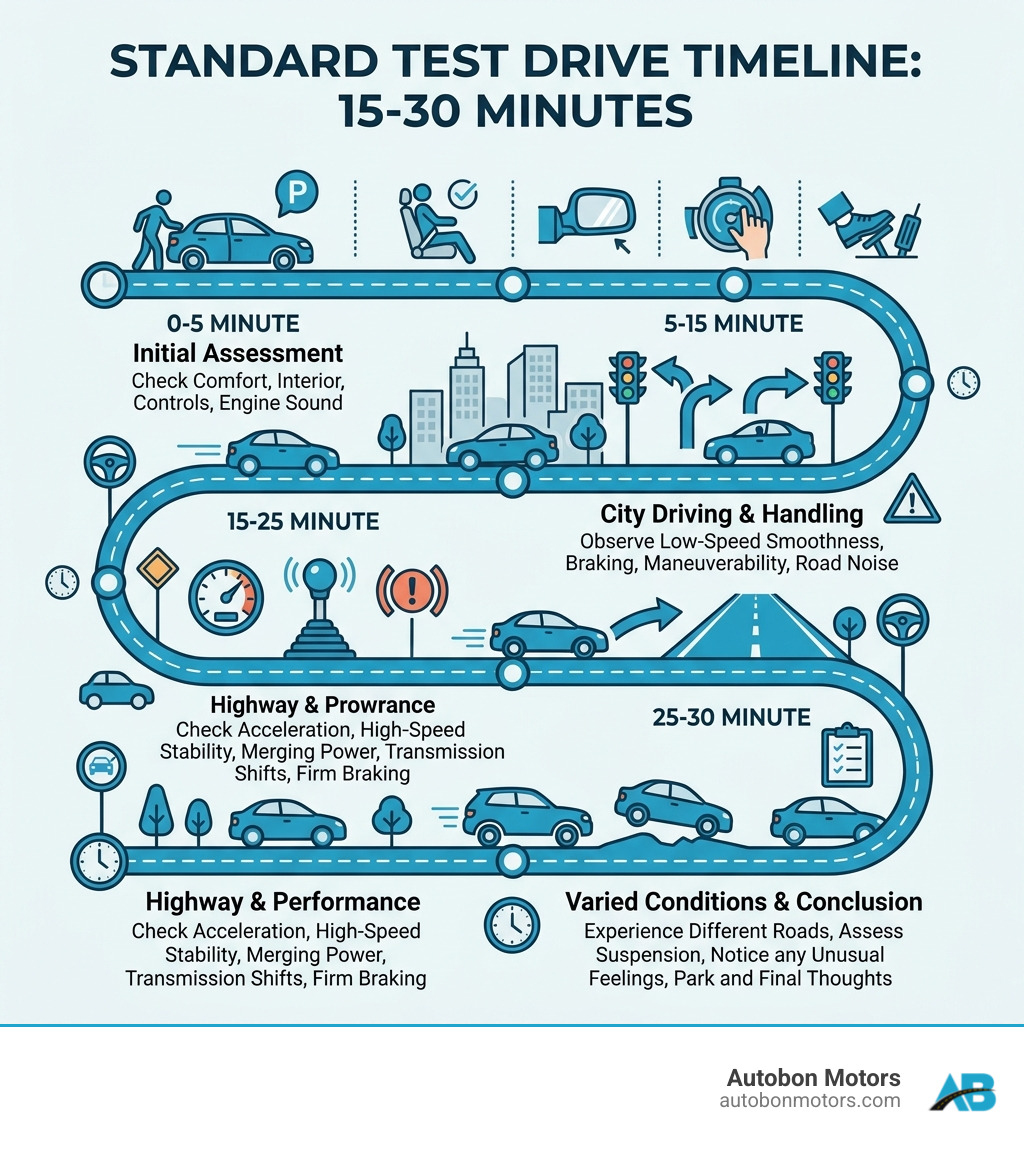
Industry standards and expert advice from sources like How long should you test drive a car? suggest that a standard test drive should last between 15 and 30 minutes. But for a used vehicle, we often recommend pushing that toward the 45-minute mark.
Why the extra time? A used car needs to reach its full operating temperature. Some transmission stutters or cooling system issues only manifest once the engine has been running for a while. If you only drive for five minutes, you’re essentially testing a "cold" car, which can hide a multitude of sins.
Duration | Purpose | What You’ll Learn |
|---|
5-10 Minutes | The "Filter" | Immediate deal-breakers (smells, loud knocks). |
15-30 Minutes | The Standard | Basic handling, comfort, and city/highway transitions. |
30-60 Minutes | The Deep Dive | Engine heat-soak, seat comfort over time, and subtle vibrations. |
24 Hours | The Lifestyle Test | Garage fit, family approval, and night-time visibility. |
Why 15-30 minutes is often considered sufficient for how long should you test drive a used car
For many buyers, the 15-to-30-minute window is the "sweet spot." It’s long enough to get a mechanical baseline without feeling like you’re taking a road trip. During this time, you can evaluate the vehicle’s primary performance metrics: acceleration, braking, and steering.
According to How to Test-Drive a New or Used Car - Consumer Reports, this duration allows you to move beyond the "new car sparkle." The initial adrenaline wears off after about 20 minutes, which is exactly when you start noticing that the seat lumbar support is a bit stiff or that there’s a persistent whistle from the side mirror at 60 MPH. Efficiency is key here; you want to use this time to hit a variety of road types—stop-and-go traffic in downtown Hollywood and a quick sprint on the I-95.
How long should you test drive a used car to evaluate lifestyle fit?
Sometimes, the mechanical health of the car is perfect, but the car is still the "wrong" choice. This is where lifestyle fit comes in. We’ve seen buyers in Dania Beach fall in love with a truck only to realize it doesn't fit in their suburban garage.
When considering how long should you test drive a used car, factor in "utility time." If you have kids, bring their car seats. If you’re an avid golfer, see if your clubs fit in the trunk without folding the seats. You might even consider our Value Your Trade tool to see how your current vehicle's utility compares to your potential new one. Testing these "real life" scenarios might add 15 minutes to your stationary inspection, but it’s time well spent to avoid a 10-year commitment to a car that doesn't fit your life.
Essential Pre-Drive Checks and Stationary Inspection
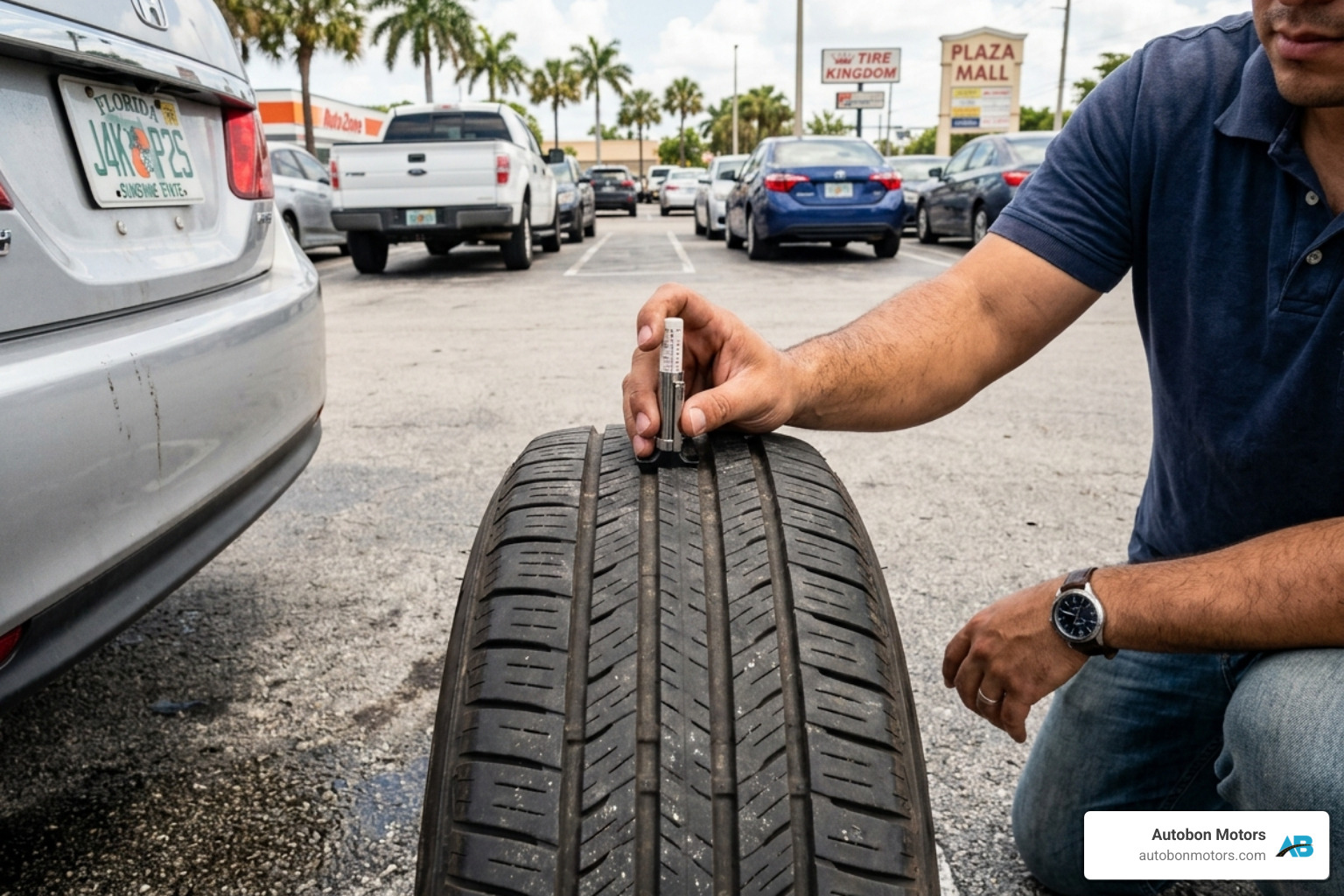
Before you even turn the key, you should spend about 5 to 10 minutes performing a stationary inspection. This is the "pre-flight" check that can save you from wasting a 30-minute drive on a lemon.
The Cold Start: Always ask the seller for a "cold start." If the engine is already warm when you arrive, they might be hiding a weak battery or a rough idle that only happens on a cold morning. Listen for rattles in those first few seconds.
Fluid Check: Pull the oil dipstick. The oil should be clean, not thick like molasses. Thick, dark oil is a sign of engine neglect.
Tire Brand Matching: Check all four tires. Are they the same brand and model? Mismatched tires often suggest the previous owner cut corners on maintenance. Check the tread depth; anything less than 3/32 inches is a safety hazard.
The "Sixth Sense" Check: Use your nose. Does the interior smell like mold or mildew? This is a massive red flag for flood damage—a common concern in South Florida.
Following a structured guide like How to Test Drive Used Cars: A 20-Step Inspection Guide ensures you don't miss these small details. While you're at it, Read Our Reviews to see how we prioritize transparency in our own inspections.
What to Evaluate During Your 30-Minute Test Drive
Once you’re on the road, your goal is to be a detective, not a passenger. We recommend a "mixed road loop" that simulates your daily driving. Don't let a salesperson dictate a route that only consists of smooth, right-hand turns. You need to see how the car handles stress.
Use our Loan Calculator to keep your budget in mind while you evaluate if the car's performance justifies the investment.
Testing Performance and Handling
To truly answer how long should you test drive a used car, you have to look at the maneuvers performed.
Steering Lock: In a safe parking lot, turn the wheel fully to the left and right while moving slowly. Listen for clicking or popping—this could indicate CV joint issues.
Hard Braking: On a clear road, perform a firm (but safe) stop. Does the car pull to one side? Do you feel a pulsing in the pedal? Pulsing usually means warped brake rotors.
Suspension: Find a road with some imperfections or speed bumps. Listen for "clunks" or "squeaks." A good car should feel composed, not like a boat on choppy water.
As noted in How to Test Drive a Used Car, you should loosely hold the steering wheel during braking to see if the alignment is off.
Assessing Comfort and Technology
In 2026, technology is just as important as the engine. Spend time with the infotainment system. Does your phone connect via Bluetooth or Apple CarPlay without a hitch?
HVAC: Test the A/C on the highest setting. In Miami and Hallandale Beach, a weak A/C isn't just an inconvenience; it's a deal-breaker.
NVH (Noise, Vibration, Harshness): Turn off the radio. Drive at highway speeds and listen for wind whistles or tire roar. If you can't have a conversation at normal volume at 70 MPH, the insulation might be poor.
Ergonomics: Are the controls logical? Can you reach the volume knob without leaning forward? These small annoyances grow into major frustrations over a three-year loan. Check out our New and Used Cars inventory to compare different interior layouts.
Identifying Red Flags and Post-Drive Next Steps
Even if the drive felt great, you must remain objective. Some red flags are subtle.
Blue Smoke: If you see blue smoke from the exhaust during acceleration, the engine is burning oil. Black smoke indicates fuel system issues.
Transmission Slips: If the engine revs up but the car doesn't speed up immediately during a gear change, the transmission is likely failing.
Vibrations: Vibration in the steering wheel usually points to front-end or tire balance issues. Vibration felt in the seat often points to the rear suspension or drivetrain.
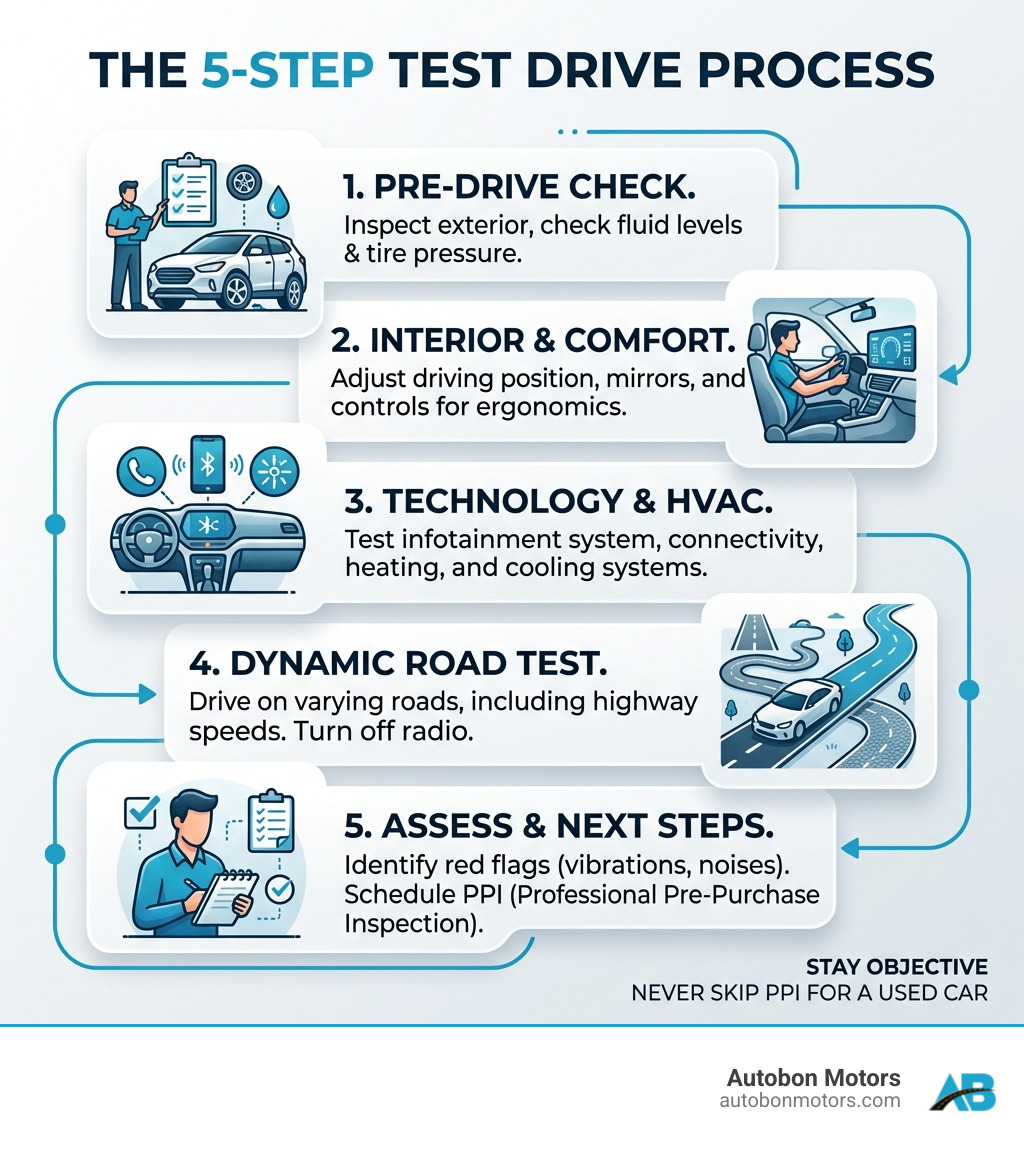
After the drive, the most important step is a Professional Pre-Purchase Inspection (PPI). As How to test-drive a car in 2025 emphasizes, a test drive is a "first date," but a PPI is a background check. A mechanic can put the car on a lift and see leaks or frame damage that you simply cannot see from the driver's seat. Never skip this step for a used car.
Frequently Asked Questions about Test Driving Used Vehicles
How many cars should I test drive for comparison?
The average buyer test drives about three vehicles before making a decision. We recommend testing your top three choices back-to-back on the same day. This keeps the "feel" of each car fresh in your mind, making it easier to spot which one has the best steering weight or the quietest cabin.
What documents do I need to bring for a test drive?
At a minimum, you need a valid driver's license. Most dealerships, including those in the Fort Lauderdale area, will also require proof of automotive insurance. If you are looking for an extended or overnight test drive, you may need to provide proof of "comprehensive and collision" coverage.
Is a professional inspection necessary after the drive?
Yes! Unless the vehicle is a Certified Pre-Owned (CPO) unit with a robust factory warranty, an independent mechanic's inspection is the best insurance policy you can buy. They have tools to scan for "hidden" error codes that haven't triggered a dashboard light yet.
Conclusion
At Autobon Motors, we believe that a well-informed customer is a happy customer. Whether you are visiting us from Miami, Hollywood, or right here in Fort Lauderdale, our goal is to give you the time and space you need to answer how long should you test drive a used car for yourself.
We pride ourselves on our customer-focused approach and fair pricing. If you're looking to sell your current vehicle quickly, our South Florida buying center offers some of the best rates in the region.
Don't rush the process. Take the 30 minutes, hit the highway, test the A/C, and bring the kids along. When you're ready to find a vehicle that truly fits your life, Browse Our Inventory and let us help you drive home with total confidence.
